

Six Thinking Hats for Local Business Marketing
In local business marketing, finding the right approach can be daunting. Edward De Bono’s Six Thinking Hats gives you a framework to make decisions. By using each hat to look at different aspects, you can improve your marketing and make better choices.
The Six Thinking Hats method looks at different angles of a problem. This looks at issues through different lenses like creativity, emotion and data. Using this approach gives you balanced thinking and helps you solve problems in new ways.
For local businesses, using these thinking hats can mean the difference between a winning campaign and one that fails. By promoting teamwork and clear communication this method not only improves marketing results but also team morale.
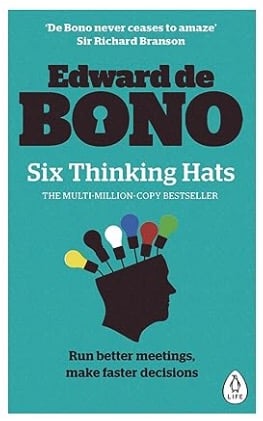
Six Thinking Hats
Order the book Six Thinking Hats from Amazon
Takeaways
- Six Thinking Hats makes decisions by looking at problems from different sides.
- Teams work better together using the framework.
- Risk in marketing is reduced with multiple viewpoints.
What are the Six Thinking Hats?
The Six Thinking Hats technique was developed by Edward De Bono to improve group decision making and creative problem solving. It uses parallel thinking where different perspectives are looked at one at a time to have a comprehensive discussion.
When we explored the Six Hats method, it seemed to encourage every team member to contribute unique viewpoints, making meetings more productive. The process simplified complex issues by assigning different thinking roles, which helped us approach problems from various angles. We found it particularly useful when tackling decision-making in group settings. It made our discussions structured, promoting clear communication and reducing confusion.
One thing to note is that it takes some practice to get used to switching “hats” smoothly. Although initially challenging, once we got the hang of it, decisions were made more comprehensively and efficiently. It’s not just about organising thoughts; it also encourages participants to consider perspectives they might normally overlook. The concept is simple, yet its application required consistent practice to truly enhance our decision-making skills.
History and Principles of the Method
Edward De Bono introduced the Six Thinking Hats to simplify thinking in groups and individuals. This method separates different types of thoughts and emotions. The idea is Parallel Thinking where people can look at different aspects of a situation without conflict.
It’s used to run meetings and discussions more efficiently. Each “hat” represents a different type of thought and breaks down the discussion into manageable chunks. By wearing one “hat” at a time you can look at ideas without overlap or confusion.
Six Hats Overview
The Six Hats are metaphorical hats representing different thinking styles each with a different focus:
- White Hat: Facts, figures and information.
- Red Hat: Emotions and feelings to acknowledge instinctive reactions.
- Black Hat: Looks for risks and negative views, be cautious.
- Yellow Hat: Looks for positives and benefits, be optimistic.
- Green Hat: Creativity and growth, new ideas.
- Blue Hat: Manages the thinking, structures the discussion like a leader.
Each of these hats looks at different aspects, so nothing is missed in the discussion. This gives a balanced view of complex problems in problem solving.
Six Thinking Hats for Marketing Strategy
You can use the Six Thinking Hats to improve various parts of your business marketing strategy. It helps to align marketing goals, strategic planning and brainstorming and creativity and innovation in campaigns.
Aligning Hats with Marketing Goals
The Six Thinking Hats involves everyone taking on different roles or perspectives in discussions. For marketing aligning these roles to specific goals gives you a rounded plan.
For example the White Hat looks at data and facts which can inform decisions based on market research. The Red Hat looks at emotional connections with the target audience and the Black Hat looks at risks and potential pitfalls in a campaign. Together these perspectives cover everything.
This will give focus and harmony in marketing teams. It will give a structured discussion and balanced decision making. Integrating these perspectives will help teams work towards their goals.
Strategic Planning and Brainstorming
Strategic planning and brainstorming are key to marketing success. The Six Thinking Hats gives you a framework to approach these sessions.
During planning each hat represents a different view. This can mean using the Yellow Hat to look at the positives and opportunities in different strategies and the Green Hat to look at new ideas.
By looking at these perspectives systematically you can find creative solutions and anticipate problems early. The method ensures everyone’s voice is heard and ideas are considered so you get more robust plans with multiple perspectives.
Innovation and Creativity in Campaigns
Innovative marketing campaigns require creativity. The Green Hat is useful here to generate new and innovative ideas. It encourages thinking outside the box and looking at unusual approaches.
The Blue Hat then manages the process to ensure ideas are fully explored and structured into actionable plans. The Six Thinking Hats keeps the balance between creativity and practicality that’s essential for successful campaigns.
By using this method marketing teams can generate new ideas and try out new approaches and get campaigns that grab attention and resonate with their audience.
Team Collaboration and Communication
The Six Thinking Hats was created by Edward de Bono to give teams a framework to improve their interaction and collaboration. By assigning roles it reduces conflict and encourages different perspectives so discussions are more productive.
Using the Hats in Meetings
Using the Six Thinking Hats in meetings will improve team communication. Each hat represents a different way of thinking from analytical to creative and encourages everyone to take on different perspectives. This will keep everyone focused on the topic at hand and reduce interruptions and tangents.
For example the White Hat looks at facts and information so team members can focus on the data without emotional interference. The Red Hat looks at emotions and feelings so team members can express themselves openly which is important for understanding team dynamics and resolving tensions. This structured approach will keep meetings focused and on purpose and increase efficiency and outcome. When done correctly this will increase the collective intelligence of the team.
Overcoming Groupthink and Bias
Groupthink can be a major obstacle to good teamwork and often leads to bad decision making. The Six Thinking Hats prevents this by encouraging different perspectives and reducing biases. By assigning thinking roles participants are forced to challenge their assumptions and have a more balanced and open minded discussion.
The Black Hat for example looks at potential risks and drawbacks so team members think cautiously. The Yellow Hat looks at positive thinking and benefits. This balanced approach reduces bias and gives a more complete view of ideas. The method also helps with conflict resolution as it reduces the likelihood of entrenched positions and creates a more harmonious and effective team environment.
Decision Making and Problem Solving
The Six Thinking Hats will help with decision making and problem solving by looking at challenges in a more complete way. By taking on different perspectives represented by each hat teams can have balanced decision making and root cause analysis.
Using Hats for Balanced Decision Making
Using the Six Thinking Hats technique will help you get balanced decision making by looking at different perspectives. Each hat represents a different way of thinking, emotional, logical or creative. For example the black hat looks at risks and shortcomings, the green hat looks at creative solutions and innovation.
This will prevent bias by ensuring all voices and views are heard. By looking at each perspective systematically teams will get a complete understanding of the problem and make more thoughtful and effective decisions.
Root Cause Analysis and Critical Thinking
Root cause analysis is key to good problem solving. The Six Thinking Hats method will enhance critical thinking by looking at facts and emotions in detail. When the white hat is used the focus is on objective data and facts so teams can identify the root cause more accurately.
The red hat allows for instincts and emotional reactions so the team gets more depth of understanding. This structured approach will encourage critical thinking by breaking down the problem into smaller parts so teams can make informed decisions and reduce the risks of jumping to conclusions. As a result solutions will be more robust and address both the symptoms and the underlying issues.
Marketing Risk Assessment and Management
Assessing and managing risk in marketing requires strategic thinking and balancing intuition with logic. By using structured approaches you can navigate the unknown and get good outcomes.
Using the Black and Yellow Hats for Risk Analysis
The Black Hat looks at potential risks in marketing strategies. This critical thinking tool looks at negative outcomes and identifies weaknesses and challenges. By using this approach you can foresee obstacles and plan for mitigation so you can make better decisions.
The Yellow Hat looks at the positive aspects of a plan despite the identified risks. It encourages you to look for opportunities and find the good in the challenges. By using both Black and Yellow Hats marketers get a balanced view and explore complete strategies that considers risk and reward. This dual approach will give you well rounded decisions that combines caution with optimism in your marketing initiatives.
Intuition and Logic for Marketing Risk Assessment
Combining intuition with logic will give you a robust framework for assessing marketing risk. Intuition allows you to draw on past experiences and gut feel so you get quick insight into potential problems. It helps you see patterns that may not be visible through data alone.
Logic uses structured analysis and evidence based assessment. Marketers apply logical thinking to the data, track trends and forecast market behaviour. Together intuition and logic will help you assess risk so you can make agile adjustments to your strategy. This blend of insight will mean your marketing decisions are data driven but also real world relevant.
FAQs
Using the Six Thinking Hats will help local businesses with their marketing. This will look at multiple perspectives so marketing will be more complete and effective.
What are the principles of the Six Thinking Hats in marketing?
The Six Thinking Hats looks at challenges from different angles by adopting six different ways of thinking. These ‘hats’ – white, red, black, yellow, green and blue – each represent a different view. This technique was developed by Edward de Bono and encourages teams to look at different aspects of marketing – facts, emotions, creativity and management processes.
How do local businesses use the Six Thinking Hats?
Local businesses can use this technique during brainstorming. By using structured time blocks for each hat you can approach new ideas with focus. For example during a product launch the white hat might look at data and the green hat at new ideas so you get a balanced approach to planning and execution.
Can you give me some examples of the Six Thinking Hats in marketing?
An example of the Six Thinking Hats in marketing could be a tech company’s campaign planning. The red hat might look at customer emotions around the product, the black hat at the risks. Other hats look at creativity or feasibility so you get a rounded strategy that considers different outcomes.
What are the benefits of using the Six Thinking Hats for local business marketing?
This will give you several benefits including multiple perspectives and no conflict during discussions. Everyone on the team will contribute so you get a complete and inclusive approach to problem solving and idea generation. This will lead to more innovative and effective marketing.
How does the Six Thinking Hats help team decision making in marketing?
This will allow teams to look at issues from all sides. It will encourage collaborative decision making by looking at all types of thinking – logical, emotional, creative. It will prevent groupthink and encourage different input so decisions will be more informed and balanced.
How will the Six Thinking Hats help creative strategy development for local businesses?
By allocating time for different thinking modes the Six Thinking Hats will boost creativity. Each hat will challenge the team to think beyond their usual thinking, create an environment for innovation. This will lead to more creative and effective marketing for local audiences and more engagement and success.

